TAPPI Journal Archive
About TAPPI Journal
As of March 2022, TAPPI Journal’s (TJ) publishing model is 100% Open Access (OA) to improve the accessibility of its published articles, increase researcher engagement and make research more visible. This new format helps researchers meet their funding and grant application requirements and potentially increase the number of citations. As in the past, the copyright remains with the author, and unlike other technical journals, TJ does not require a publication fee. Read more.
Benefits of Open Access Publishing
Digital Issue Library
Editorial: AI in Higher Education: Implications for scholarly publishing, TAPPI Journal September 2026
October 04, 2026
Even as we grapple with the positive and negative implications of artificial intelligence (AI), it has become increasingly embedded in our personal lives and work, including higher education. A recent snapshot of AI’s impact in this area is the Digital Education Council’s (DEC’s) AI in Higher Education Global Survey 2026. Founded in early 2024 to study how AI and digital transformation impact higher education, learning, and workforce skills, DEC is made up of member institutions throughout the world in academia and vocational learning. It currently has more than 200 members in over 42 countries.
Nonlinear modeling of batch digester discharge dynamics with rheology-driven hydraulic transport and drainability coupling, TAPPI Journal September 2026
October 04, 2026
ABSTRACT: Batch digester blowdown constitutes a strongly nonlinear transient transport process governed by the coupled evolution of pulp consistency, slurry density, hydraulic resistance, liquid inventory, and discharge line dynamics. A control-oriented nonlinear formulation is developed by coupling dry fiber and free liquor mass balances with phase volume reconstruction, consistency-dependent hydraulic resistance, channeling and drainability effects, and a power law head flow relationship derived within a lumped hydraulic inertance framework. A fixed-gain PI con troller obtained from local linearization is employed as the conventional benchmark, whereas an integral sliding mode controller (SMC) explicitly compensates the nonlinear time-varying hydraulic structure and bounded disturbances. Both strategies are evaluated under identical actuator constraints and sequential perturbations involving oppos ing head, hydraulic resistance, channeling, drainability, and dilution. Numerical results demonstrate lower root mean-square error, integral absolute error, and peak flow-tracking error for the SMC, with rapid recovery toward the prescribed sliding boundary layer and improved robustness to variations in the nonlinear flow exponent n. Cumulative electrical energy and batch-specific specific energy consumption remain comparatively similar, indicat ing that the principal SMC benefit is enhanced hydraulic regulation rather than substantial batch energy reduction. Specific energy consumption is an established metric for energetic assessment of slurry transport. Model-based hydraulic demand, electrical power, and sliding manifold surfaces further characterize the nonlinear operating domain. The resulting framework provides a computational proof-of-concept for modeling and control of transient batch digester discharge systems.
Pressure drop characteristics of steam condensation flow in triangular channels for multi-channel cylinder dryers, TAPPI Journal September 2026
October 04, 2026
ABSTRACT: This study investigates the condensation pressure drop characteristics of steam in the channels of multi-channel drying cylinders, which remain insufficiently understood. An experimental system was established using a horizontal mini-channel with a triangular cross-section and a hydraulic diameter of 4.09 mm. Flow visualization combined with a high-precision data acquisition system was employed to systematically examine the effects of steam mass flux (10•60 kg/(m²·s)), inlet temperature (110°C•140°C), and cooling water flow rate (100•500 kg/h) on the frictional pressure drop during condensation. The results indicate that the two-phase frictional pressure drop increases with rising steam mass flux but decreases with increasing saturation temperature, while the effect of cooling water flow rate becomes more pronounced under lower temperature conditions. In addition, several existing two-phase flow pressure drop correlations were evaluated against the experimental data. Based on a comparative assessment of eight existing correlations, a new predictive model was developed through regression analysis, achieving a mean absolute percentage error (MAPE) of 19.56%. These findings elucidate the pressure drop mechanism of steam condensation in triangular channels and establish a high-precision predictive model, providing theoretical guidance and a critical tool for the engineering design and energy consumption optimization of multi-channel drying cylinders.
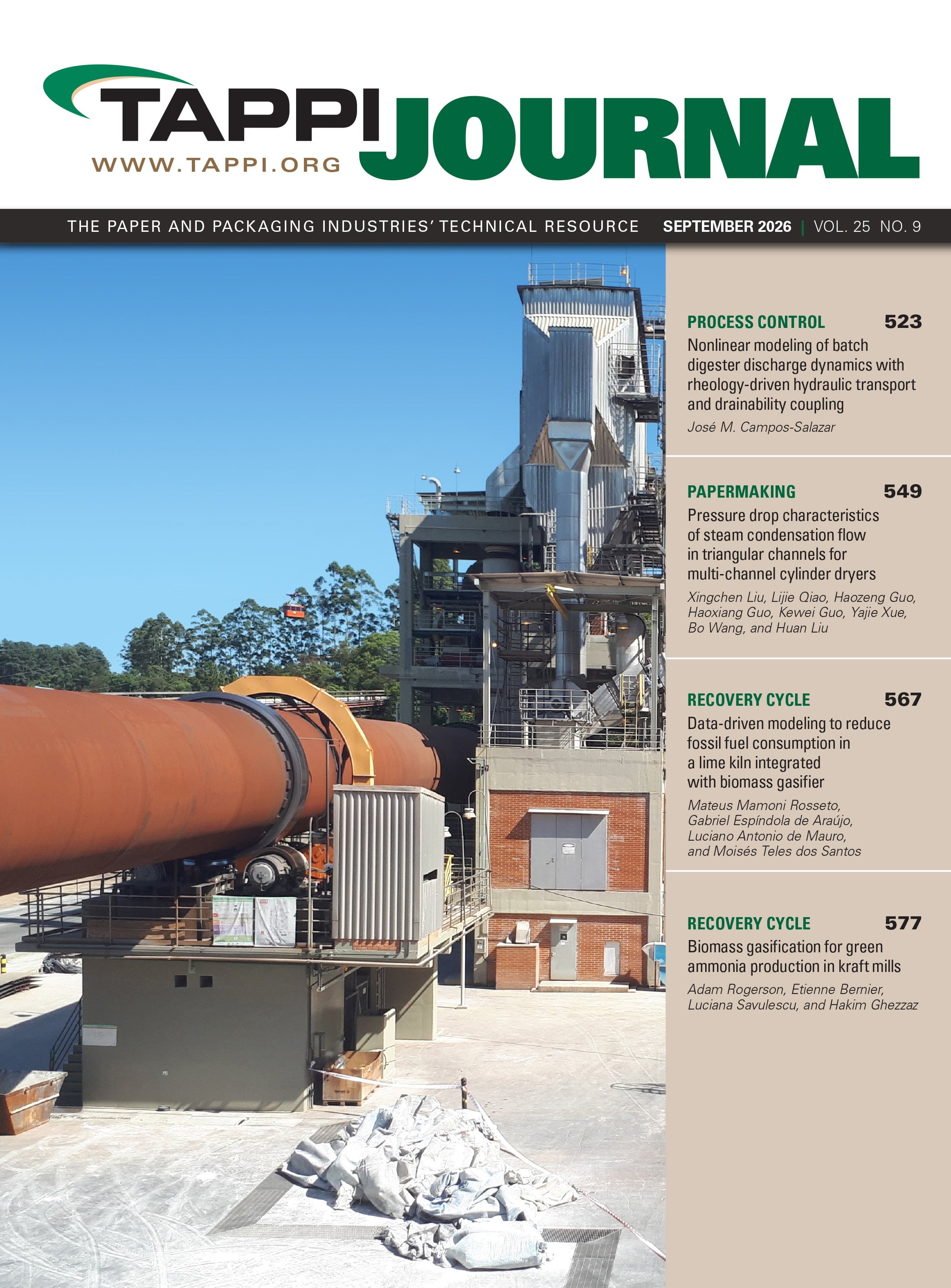
Data driven modeling to reduce fossil fuel consumption in a lime kiln integrated with biomass gasifier, TAPPI Journal September 2026
October 04, 2026
ABSTRACT: Biomass gasification, although already known and applied, is currently being consolidated as a sustainable alternative in the pulp industry, contributing to the reduction of fossil carbon dioxide (CO2) emissions and to the utilization of forest residues. In this context, pulp mills are beginning to adopt biomass gasification within their chemical recovery cycles by integrating the technology with lime kilns. However, further process studies are still needed to support and optimize this application. Thus, the present study aimed to analyze lime mud feed temperature by applying an artificial neural network model to a gasification system integrated with a lime kiln. For this evaluation, 10 periods of system stability throughout 2024 were selected under different operational conditions. Data from 28 potential predictive variables were collected, a total of 348 observations. This dataset was then processed using R software, where data treatment and model dimensionality reduction were performed, resulting in 10 predictive variables between gasifier and kiln. Next, the dataset was randomly divided into training (70% of the observations) and testing data. The established neural network model (using “neuralnet” package) was optimized, resulting in a configuration containing one hidden layer with three neurons. This setup enabled optimal estimation of the flue gas kiln outlet temperature, with mean absolute error (MAE) = 3.0°C and root mean square error (RMSE) = 4.1°C, applying the resilient backpropagation algorithm with backtracking — both below the thermocouple’s measurement error (±5.0°C) for the evaluated average temperature range (668.2°C). When the same dataset was modeled using the resilient backpropagation algorithm without backtracking, even better results were achieved: MAE = 2.5°C and RMSE = 3.7°C. Thus, after evaluating these and other configurations, it was concluded that the best model required 10 predictive variables and the backpropagation algorithm without backtracking to determine flue gas kiln outlet temperature. These results provide a better understanding of how gasifier and kiln variables influence the temperature in the lime kiln, which is essential to improve control and optimize the calcination process, avoiding supplementary fossil fuel consumption.
Biomass gasification for green ammonia production in kraft mills, TAPPI Journal September 2026
October 04, 2026
ABSTRACT: As the global energy sector transitions toward net-zero emissions, kraft pulp mills present a compelling opportunity to produce green fuels and achieve net-negative emissions by capturing biogenic carbon, helping offset hard-to-abate sectors. This study explores the techno-economics of integrating biomass gasification for green ammonia production within kraft mills, using KraftSIM modeling to evaluate ammonia production, steam balance, emissions, and utility impacts. The proposed design enables energy and water system integration with the existing mill and allows for a gradual scale-up without disrupting the chemistry and operation of the recovery cycle. Across five scenarios representing different biomass gasification rates ranging from 100 to 1000 bone-dry metric tons per day (BDMT/d), the process yields ammonia at approximately 0.51 metric tons per bone-dry metric ton (t/ BDMT), while generating significant low- and medium-pressure steam and hot water that offset mill utility demands. The incineration of pressure swing adsorption tail gas and ammonia plant purge gas in the power boiler reduces biomass combustion and enhances power boiler efficiency. Economic analysis suggests a net revenue potential of approximately CA$380/BDMT, which could increase with the implementation of biogenic carbon pricing. Overall profitability is strongly influenced by biomass procurement costs, electricity prices, and prevailing green fuel and chemical market premium. This work outlines a practical, near-term decarbonization pathway for kraft mills by coupling green fuel production with potential opportunities for carbon removal.