
 For Safety, Sylvamo Puts People Before Paper
This article will appear in the forthcoming Jan/Feb 2026 issue of Paper360°, TAPPI's flagship member magazine. It is being excerpted here as a special "sneak peek" for Ahead of the Curve readers with an interest in industry safety. Access Paper360° issue archives online.
In 2024, Sylvamo was at a crossroads. Safety performance was declining, and more people were experiencing injuries during routine tasks—especially hand injuries. Company leaders knew change wasn’t optional, it was necessary.
Deep Roots, New Path
Sylvamo's story is unique; though formed only five years ago, it shares its roots with industry giant International Paper, which has a history stretching back more than 100 years. The company was created in 2021 when IP spun off its global printing papers business.
Headquartered in Memphis, TN, Sylvamo employs more than 6,500 people worldwide, with mills in North America, Latin America, and Europe. Its product mix is focused on uncoated freesheet paper, giving Sylvamo the freedom to forge its own path as a company while still being able to rely on experienced leaders and its iconic paper brands.
A values‑driven culture starts with a simple truth: every person deserves to go home safe and well. Sylvamo leaders knew that the only choice was to create a company-wide effort that reinforced its deep commitment to the safety of its people. They knew they would need to take a holistic approach, focusing on a combination of people and tools to take it to the next level of safety performance. Finally, they knew their effort would need to be impactful: They wanted to involve every global team member, both manufacturing and non-manufacturing, in a safety discussion to understand what was missing and how everyone could work together to improve.
That is how the "Global Safety Standdown" was born. Growing from their safety rally cry of "People Before Paper™", the Safety Standdown effort involved stopping work at every location around the world, to engage employees in a way they'd never forget.
"We were looking for a way to help every employee focus on safety—to spark real conversations with every team about what we need to focus on," says Megan Inman, communications manager, Operational Excellence at Sylvamo. “We wanted them to get the message of how serious we were about their safety—and that we really do expect our team members to put people before making paper. The safety and well-being of our employees is our most important responsibility."
The Standdown Process
The planning began in April 2024, as mill managers and the Environment, Health, and Safety teams were informed about the initiative and received standdown content, procedures, and safety information to share with their teams. Leadership set clear objectives:
- Stop work and alert all team members to the increase in injuries when performing routine tasks.
- Involve every team member, both manufacturing and non-manufacturing, in a safety discussion to understand what was missing and how teams could work together to improve.
- Ensure every team member understands what "People Before Paper" means.
"It took a couple weeks of prep, and managers kept the plan confidential until they could schedule the Standdowns at a time that worked best for their mills. We wanted that surprise element," said Inman.
Standdowns officially began the week of May 20. Seeking feedback from every team member, both manufacturing and non-manufacturing, was key. At locations with shift team members, managers scheduled multiple standdowns to make sure no team member was left out.
Lindsay Macaulay, Sylvamo's global director, Health and Safety, called it a "powerful event that demonstrates the effectiveness of stop work authority and that everyone has a voice when it comes to safety.
“We have the opportunity to show, more than ever, that we care about our employees by taking safety and well-being to heart and truly putting People Before Paper,” Macaulay says.
Coming out of the event, employees and teams were empowered to share safety ideas, keep conversations going, and stop work when unsafe conditions exist. “Listening to different challenges and perspectives from teams across the mill ingrained the importance of coming from a place of care when having safety conversations and stopping work,” said Barbie Wilburn, area manufacturing excellence leader, Ticonderoga mill. “The Standdown set the tone on how serious we are about the safety of ourselves and our team members.”
Stopping work unexpectedly was certainly an attention-getter.
Making Change Happen
By mid-June, Health and Safety was ready to present initial feedback to the senior leadership team and facility leaders. "One of the first things we realized was the need to continue smaller group discussions so we could dig deeper into what employees were actually experiencing—and where we could strengthen risk-related scenarios," says Inman. "We also heard clearly that employees wanted more communication about where we were with safety on a global level. We answered this need by expanding 'Make Change Happen' projects."
Make Change Happen projects are designed to proactively prevent injuries by empowering individuals and teams to implement targeted safety improvements. These initiatives actively engage employees in safety solutions by identifying hazards and risks, describing the conditions around the task or risk, and developing a solution. During a quarterly global call, manufacturing locations present a Make Change Happen project to share safety findings, encouraging questions and dialogue. The goal is to make all Sylvamo mills safer by leveraging findings across mills. All employees are invited and anyone can share.
It is a way of "reaching across the waters," Inman says, that quickly expanded Sylvamo's safety knowledge as an organization: "A lot of the same work happens across mills and regions. Sharing best practices globally became a powerful engagement tool."
Other solutions developed from Standdown feedback include new technologies (for example, installing cameras to help identify risks and help prevent employees from entering potentially unsafe situations;) and additional reliability training.
To support the demands of increased training needs, Sylvamo developed a simple but effective way to preserve critical industry knowledge lost when team members retired: ask them to come back as mentors and trainers.
"Our workforce has gotten younger, and we needed a way to ensure effective knowledge transfer. That includes knowledge that isn't necessarily written down; there are things you only know if you've been in the paper industry 40 years. That experiential knowledge is incredibly important," says Pat Wilczynski, senior vice president, Operational Excellence.
Bringing experienced hands back as contractors has helped Sylvamo "fill in the gaps" for current employees. "This year, we are really focused on training, certification, and mastery with skills," adds Wilczynski.
Sylvamo recognizes that this initiative is about far more than knowledge transfer. It strengthens reliability, which directly strengthens safety. Experienced team members now help employees understand how each skill relates to the big picture for reliability—and when operations are more reliable, then they are going to experience fewer failures, creating a safer environment for everyone.
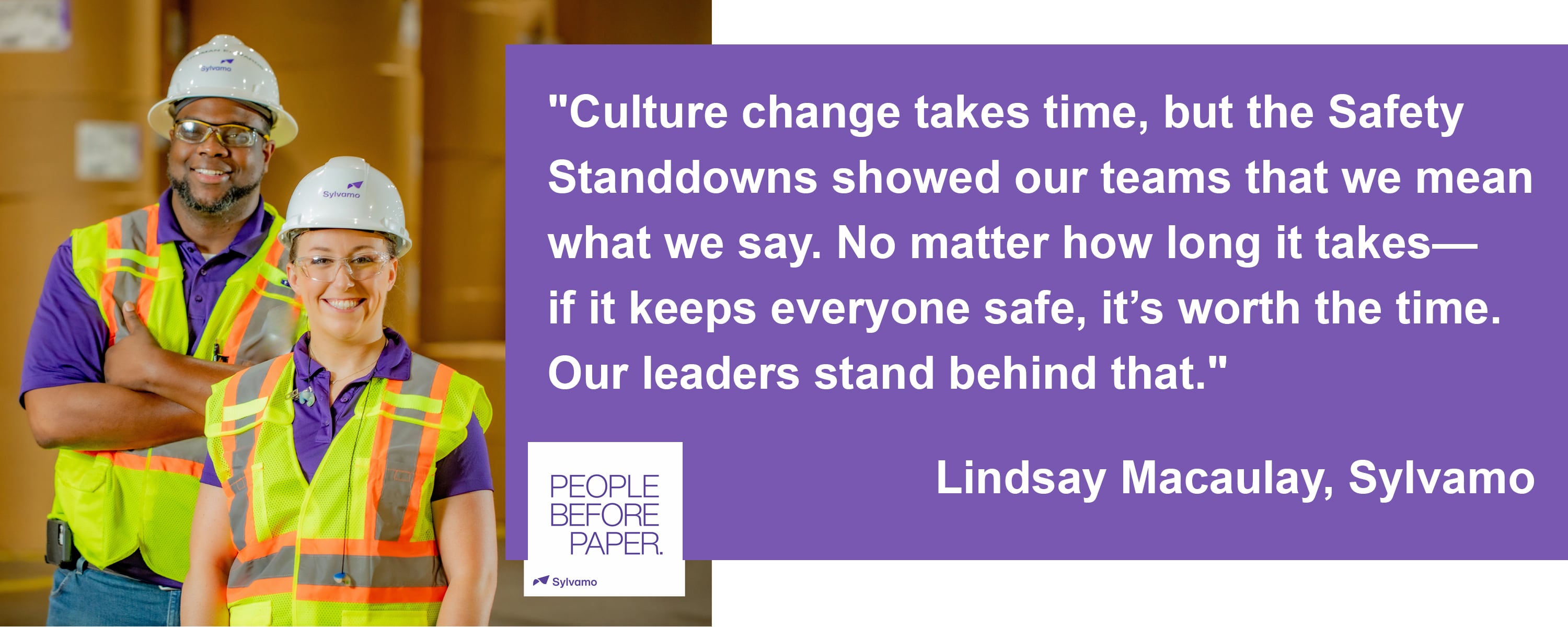
"There was a time in our industry when the focus appeared to be solely on production. By choosing to put people before paper, we’re building a culture that values safety, care, and long‑term success," Macaulay concludes. "Culture change takes time, but the Standdowns showed our teams that we mean what we say. No matter how long it takes—if it keeps everyone safe, it’s worth the time. Our leaders stand behind that."
Inside this Section
-
- Arthur J. Ragauskas, Ph.D., Rises to Role of TAPPI Journal Editor-in Chief
- Advanced Coating Symposium 2026 Call for Speakers Now Open
- New President and CEO Annoucement
- TAPPI Announces Call for Speakers for TAPPICon 2026
- TAPPI Announces Important Changes to Its Nano Division
- TAPPI’s Paper and Board Division Announces Formation of a Fiber Molding Committee
- Keynote Speakers Announced for TAPPI Nano 2025 in Girona, Spain
- TAPPI Journal Awards Best Research Paper for 2024
- TAPPI Selects Fellows and Outstanding Young Professional for 2025
- Group Chief Executive Officer and President of Smurfit Westrock Receives TAPPI/PIMA 2025 Executive of the Year Award
- David Schwerbel, Principal of Telos-US, Named Recipient of TAPPI’s Paul W. Magnabosco Outstanding Local Section Award
- Anthony “Tony” Lyons, Ph.D., Honored with TAPPI’s 2025 Herman L. Joachim Distinguished Service Award
- Wadood Y. Hamad, Ph.D., Named Recipient of TAPPI’s 2025 Gunnar Nicholson Gold Medal Award
- TAPPICon 2025 Expands to Include Pulp and Fiber Innovation
- Important Leadership Changes in 2025
- TAPPI Journal Announces New Editorial Board Members
- Subject Matter Experts Invited to Present at TAPPICon 2025
- Early Bird Registration Opens for Two Co-Located TAPPI Courses
- TAPPI/AICC’s 2024 Box Manufacturing Olympics Winners Announced
- TAPPI’s Corrugated Packaging Council Elects Two New Members
- SuperCorrExpo 2024 comes to a close, exceeding expectations
- Fiberglass Mat Community to Meet October 1-3, 2024 in Denver, CO
- TAPPI/AICC Announce Cris Carter to Keynote at SuperCorrExpo® 2024
- TAPPI & AICC Now Accepting Entries for Box Manufacturing Olympics
- TAPPI & AICC Announce Attendee Registration Opening for SuperCorrExpo® 2024
- Sean Ireland, CEO of CapaTec, to Deliver Keynote Address at TAPPI's 2024 International Conference on Nanotechnology for Renewable Materials (Nano)
- Sean Ireland, CEO of CapaTec, to Deliver Keynote Address at 2024Nano
- CEO of ND Paper Receives TAPPI/PIMA 2024 Executive of the Year Award
- TAPPI Selects Fellows and Outstanding Young Professionals for 2024
- Converter Advanced Registration Discount (CARD) Program Provides Affordable, One Price Registration
- Paula Hajakian Honored with TAPPI’s 2024 Herman L. Joachim Distinguished Service Award
- Seyhan Nuyan, Ph.D., Named Recipient of TAPPI’s 2024 Gunnar Nicholson Gold Medal Award
- What’s In Your Flexible Packaging?
- TAPPI Announces Newly Elected Directors from Irving Consumer Products, Valmet and Auburn University
- TAPPI Journal Awards Best Research Paper for 2023 and Announces Editorial Board Changes for 2024
- Early-bird Registration Opens for the 2024 TAPPI International Conference on Nanotechnology for Renewable Materials
- TAPPI/AICC Announce Jake Hall and Greg Gumbel to Keynote at SuperCorrExpo
- Corrugated Boot Camp Hosted by Chicago TAPPI Following Annual Board Meeting
- TAPPI Foundation Names 2023-2024 Scholarship Winners
- Call for Presentations Extended for TAPPI’s FlexPack PLACE Conference
- Fiberglass Mat Community to Meet October 17-19, 2023 in Chattanooga, TN
- Abstracts Sought for TAPPI’s FlexPack PLACE Conference
- TAPPI Announces CorrExpo 2023 What’s New/Tech Talks Presentations
- TAPPI Announces 2023 Award Winners For the Corrugated Packaging Division
- Announcing TAPPI’s CorrExpo 2023 Box Plant Deal
- TAPPI’s Women in Industry Division Names Sappi North America’s Vice President of Research, Development and Sustainability and North Carolina State University’s Assistant Dean for Advancement in the College of Natural Resources Recipients of the 2023 Woman
- Announcing TAPPI’s CorrExpo 2023 Keynoters: Bob Chapman, Chairman and CEO, Barry-Wehmiller and World-Class Drummer Mark Schulman
- President and CEO of Stora Enso Receives TAPPI/PIMA 2023 Executive of the Year Award
- TAPPI Journal Awards Best Research Papers for 2022
- TAPPI Selects Fellows and Outstanding Young Professionals for 2023
- Brian N. Brogdon Honored with TAPPI’s 2023 Herman L. Joachim Distinguished Service Award
- North Carolina State University’s Professor and Buckman Distinguished Scientist Named Recipient of TAPPI’s 2023 Gunnar Nicholson Gold Medal Award
- TAPPI Announces New Directors and Officers of the Board
- TAPPI Journal Announces New Editorial Board Members
- Chemical Recovery in the Alkaline Pulping Processes, Fourth Edition Now Available from TAPPI Press
- Education and Networking to Take Center Stage at Fiberglass Mat Event
- Innovation to Take Center Stage at Biennial European PLACE Conference
- New Handbook Assists Paper Mills to Achieve Efficient Operation through Utilization of Process Chemicals
- Chairman and CEO of Green Bay Packaging Inc. Receives TAPPI/PIMA 2022 Executive of the Year Award
- TAPPI Journal Awards Best Research Paper for 2021
- TAPPI Selects Fellows and Outstanding Young Professionals for 2022
- Paul W. Magnabosco Outstanding Local Section Award
- John Neun Named Recipient of 2022 Herman L. Joachim Distinguished Service Award
- WestRock’s Director-Research and Innovation Named Recipient of TAPPI’s 2022 Gunnar Nicholson Gold Medal Award
- Introducing TAPPI’s Newest Directors
- Interactive Panel Provides Perspectives on 2025 Sustainability Initiatives In the Flexible Packaging Industry
- Two Major Training Events for the Pulp and Paper Industry Set for January 10 – 13, 2022 in St. Petersburg, Florida
- TAPPI Foundation Awards 2021-2022 Scholarships
- Lime Kilns and Recausticizing: The Forgotten Part of a Kraft Mill Now Available from TAPPI Press
- TAPPI Journal Awards Two Best Research Papers for 2020
- New TAPPI Board of Directors and Officers Announced
- TAPPI Announces 2020 Engineering Division Technical Award and Beloit Prize Winner
- TAPPI Academy Announces Addition of Web and Winding Courses to eLearning Offerings
- TAPPI Announces Cash Prize to Accompany TAPPI Journal Best Research Paper Award
- Master Papermaking Additives to Gain Competitive Advantage and Better Meet Customers’ Needs
- Film Extrusion Manual, Third Edition Now Available from TAPPI Press
- TAPPI Selects Fellows and Outstanding Young Professionals for 2020
- Black Liquor Evaporation Now Available from TAPPI Press
- Kraft Recovery Boilers, Third Edition Now Available From TAPPI Press
-
- April 2019 Committee of the Month - Runnability Planning Committee
- Mentor Match Signup - Spring 2019
- A Guide to the Nanotechnology used in the Average Home
- 65 North American Companies Remove Go Paperless - Go Green Claims
- 5,000 journals articles and conference papers now available to search
- 2017 starts with sales soaring for paper diaries, notebooks and planners
- 20 never seen before packaging designs
- Better Together Podcast
-
- My TAPPI Story: McKenna Goulette
- My TAPPI Story: Naomi Gehling
- My TAPPI Story: Leslie Petrie
- My TAPPI Story: David Maddux
- My TAPPI Story: Eupidio Scopel
- My TAPPI Story: Prakash Malla
- My TAPPI Story: Doug Coffin
- My TAPPI Story: Rory Wolf
- My TAPPI Story: Peter Hart
- My TAPPI Story: Greg Jones
- My TAPPI Story: Gabriele Pinckney
- My TAPPI Story: Jimmy Jong
- My TAPPI Story: Mike Farrell