
 Deep tech startup Reduciner introduces novel technology to turn captured carbon into sustainable fuels
This article was originally published on the News page of VTT, a Finland-based research, development and innovation partner and one of the leading research organizations in Europe. It is being shared here for Ahead of the Curve readers interested in technology that can help manufacturers remain competitive and sustainable.
As energy costs rise in the renewable fibers industry, marketable side streams become an area of increasing interest. A new start-up from Finland's VTT Research consortium may help pulp companies remain both sustainable and profitable.
Reduciner, a deep tech startup originating from VTT, is commercializing a novel high-temperature technology that enables industrial companies to turn captured carbon dioxide (CO2) into usable fuel and valuable industrial raw materials. The company raised EUR 3.6 million (about US$4.2 million) in its first funding round, consisting of equity funding from Voima Ventures, Lifeline Ventures, and Mikko Kodisoja Foundation. In addition, VTT has transferred the underlying user rights to the technology and IP as an in-kind investment to the newly established company.
Reduciner’s innovative technology addresses one of the most difficult challenges in climate change mitigation: how to turn unavoidable industrial emissions into an asset. For industrial customers, including pulp producers, it offers a cost-efficient way to profitably use captured CO₂, reduce dependence on fossil fuels, and improve competitiveness in a low-carbon economy.
Reduciner’s technology involves a proprietary thermochemical process that efficiently converts CO₂ into carbon monoxide (CO), using renewable electricity and biogenic carbon. The innovation allows indirect electrification of combustion processes, enabling large-scale production of sustainable fuels and chemicals and a significant reduction of industrial carbon dioxide emissions globally. Since CO is already compatible with existing industrial systems, the solution allows companies to reduce emissions without costly infrastructure changes.
Unlike many carbon reduction technologies, Reduciner’s solution is designed to be economically viable from the outset. A key driver of this is the production of activated carbon as a valuable co-product, which improves overall process economics and reduces reliance on policy incentives or rising fossil fuel prices. Activated carbon is typically used in water and gas purification, and due to tightening regulations, its use is expected to increase heavily in the near future.
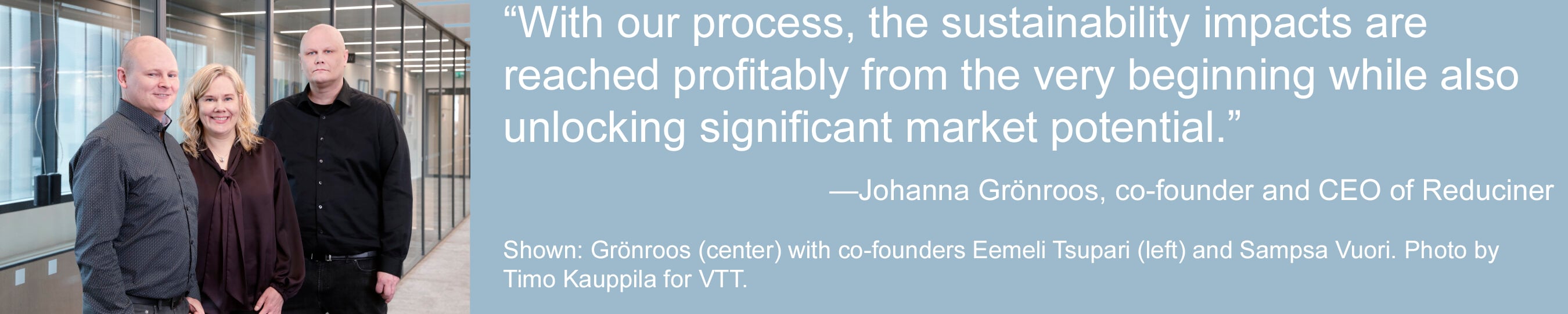
“Most technologies that seek to replace fossil fuels with more sustainable ones require rebuilding of infrastructure. Reduciner’s technology converts CO2 into CO, which is compatible with existing machinery, allowing the solution to be deployed faster and more cost-efficiently,” says Johanna Grönroos, co-founder and CEO of Reduciner. “What makes Reduciner stand out... is that with our process, the sustainability impacts are reached profitably from the very beginning while also unlocking significant market potential.”
The technology produces synthesis gas rich in CO, which can be used in a wide range of industrial processes and as a feedstock for producing synthetic hydrocarbons, for example methanol. Compared to production of hydrocarbons by conventional CO₂-based processes, using carbon monoxide significantly improves efficiency and cost-effectiveness, and reduces the need for costly inputs such as hydrogen, leading to a substantial improvement in overall process profitability.
“Reduciner stands out because it is already doing what many industrial climate companies can so far only promise on paper: validating the technology while advancing commercial discussions and solving real customers' problems,” says Pontus Stråhlman, partner at Voima Ventures.
The technology is particularly well-suited for hard-to-abate heavy industry sectors such as lime, cement, steel, and pulp. The lime industry, for example, currently uses expensive fuels and produces unavoidable carbon dioxide emissions. However, the carbon dioxide can be captured from the lime kiln, processed with Reduciner’s technology, and used as fuel in the same kiln, closing the carbon loop. Lime is one of the most extensively used materials in the world, and the industry thereby contains vast emission abatement potential.
The technology is based on several years of research at VTT and has been validated through pilot-scale testing. The commercialization phase began in 2026 and includes small-scale demonstration installations, with the first industrial-scale deployments in Finland, and broader international expansion targeted before 2030.
VTT’s role is to accelerate growth, renew industries and strengthen resilience through technology and innovation. Establishing new startups is one of its means of creating impact, and Reduciner is an excellent example of this. "At VTT, we don’t innovate for the lab—we innovate for the world. Our work is guided by a clear principle: technology must reach the market to make a real difference,” says Antti Arasto, vice president, Industrial Energy and Hydrogen at VTT.
Readers interested in learning more about Reduciner can visit www.reduciner.com or contact Antti Arasto at antti.arasto@vtt.fi; or visit vttresearch.com to learn more about VTT.
Inside this Section
-
- Arthur J. Ragauskas, Ph.D., Rises to Role of TAPPI Journal Editor-in Chief
- Advanced Coating Symposium 2026 Call for Speakers Now Open
- New President and CEO Annoucement
- TAPPI Announces Call for Speakers for TAPPICon 2026
- TAPPI Announces Important Changes to Its Nano Division
- TAPPI’s Paper and Board Division Announces Formation of a Fiber Molding Committee
- Keynote Speakers Announced for TAPPI Nano 2025 in Girona, Spain
- TAPPI Journal Awards Best Research Paper for 2024
- TAPPI Selects Fellows and Outstanding Young Professional for 2025
- Group Chief Executive Officer and President of Smurfit Westrock Receives TAPPI/PIMA 2025 Executive of the Year Award
- David Schwerbel, Principal of Telos-US, Named Recipient of TAPPI’s Paul W. Magnabosco Outstanding Local Section Award
- Anthony “Tony” Lyons, Ph.D., Honored with TAPPI’s 2025 Herman L. Joachim Distinguished Service Award
- Wadood Y. Hamad, Ph.D., Named Recipient of TAPPI’s 2025 Gunnar Nicholson Gold Medal Award
- TAPPICon 2025 Expands to Include Pulp and Fiber Innovation
- Important Leadership Changes in 2025
- TAPPI Journal Announces New Editorial Board Members
- Subject Matter Experts Invited to Present at TAPPICon 2025
- Early Bird Registration Opens for Two Co-Located TAPPI Courses
- TAPPI/AICC’s 2024 Box Manufacturing Olympics Winners Announced
- TAPPI’s Corrugated Packaging Council Elects Two New Members
- SuperCorrExpo 2024 comes to a close, exceeding expectations
- Fiberglass Mat Community to Meet October 1-3, 2024 in Denver, CO
- TAPPI/AICC Announce Cris Carter to Keynote at SuperCorrExpo® 2024
- TAPPI & AICC Now Accepting Entries for Box Manufacturing Olympics
- TAPPI & AICC Announce Attendee Registration Opening for SuperCorrExpo® 2024
- Sean Ireland, CEO of CapaTec, to Deliver Keynote Address at TAPPI's 2024 International Conference on Nanotechnology for Renewable Materials (Nano)
- Sean Ireland, CEO of CapaTec, to Deliver Keynote Address at 2024Nano
- CEO of ND Paper Receives TAPPI/PIMA 2024 Executive of the Year Award
- TAPPI Selects Fellows and Outstanding Young Professionals for 2024
- Converter Advanced Registration Discount (CARD) Program Provides Affordable, One Price Registration
- Paula Hajakian Honored with TAPPI’s 2024 Herman L. Joachim Distinguished Service Award
- Seyhan Nuyan, Ph.D., Named Recipient of TAPPI’s 2024 Gunnar Nicholson Gold Medal Award
- What’s In Your Flexible Packaging?
- TAPPI Announces Newly Elected Directors from Irving Consumer Products, Valmet and Auburn University
- TAPPI Journal Awards Best Research Paper for 2023 and Announces Editorial Board Changes for 2024
- Early-bird Registration Opens for the 2024 TAPPI International Conference on Nanotechnology for Renewable Materials
- TAPPI/AICC Announce Jake Hall and Greg Gumbel to Keynote at SuperCorrExpo
- Corrugated Boot Camp Hosted by Chicago TAPPI Following Annual Board Meeting
- TAPPI Foundation Names 2023-2024 Scholarship Winners
- Call for Presentations Extended for TAPPI’s FlexPack PLACE Conference
- Fiberglass Mat Community to Meet October 17-19, 2023 in Chattanooga, TN
- Abstracts Sought for TAPPI’s FlexPack PLACE Conference
- TAPPI Announces CorrExpo 2023 What’s New/Tech Talks Presentations
- TAPPI Announces 2023 Award Winners For the Corrugated Packaging Division
- Announcing TAPPI’s CorrExpo 2023 Box Plant Deal
- TAPPI’s Women in Industry Division Names Sappi North America’s Vice President of Research, Development and Sustainability and North Carolina State University’s Assistant Dean for Advancement in the College of Natural Resources Recipients of the 2023 Woman
- Announcing TAPPI’s CorrExpo 2023 Keynoters: Bob Chapman, Chairman and CEO, Barry-Wehmiller and World-Class Drummer Mark Schulman
- President and CEO of Stora Enso Receives TAPPI/PIMA 2023 Executive of the Year Award
- TAPPI Journal Awards Best Research Papers for 2022
- TAPPI Selects Fellows and Outstanding Young Professionals for 2023
- Brian N. Brogdon Honored with TAPPI’s 2023 Herman L. Joachim Distinguished Service Award
- North Carolina State University’s Professor and Buckman Distinguished Scientist Named Recipient of TAPPI’s 2023 Gunnar Nicholson Gold Medal Award
- TAPPI Announces New Directors and Officers of the Board
- TAPPI Journal Announces New Editorial Board Members
- Chemical Recovery in the Alkaline Pulping Processes, Fourth Edition Now Available from TAPPI Press
- Education and Networking to Take Center Stage at Fiberglass Mat Event
- Innovation to Take Center Stage at Biennial European PLACE Conference
- New Handbook Assists Paper Mills to Achieve Efficient Operation through Utilization of Process Chemicals
- Chairman and CEO of Green Bay Packaging Inc. Receives TAPPI/PIMA 2022 Executive of the Year Award
- TAPPI Journal Awards Best Research Paper for 2021
- TAPPI Selects Fellows and Outstanding Young Professionals for 2022
- Paul W. Magnabosco Outstanding Local Section Award
- John Neun Named Recipient of 2022 Herman L. Joachim Distinguished Service Award
- WestRock’s Director-Research and Innovation Named Recipient of TAPPI’s 2022 Gunnar Nicholson Gold Medal Award
- Introducing TAPPI’s Newest Directors
- Interactive Panel Provides Perspectives on 2025 Sustainability Initiatives In the Flexible Packaging Industry
- Two Major Training Events for the Pulp and Paper Industry Set for January 10 – 13, 2022 in St. Petersburg, Florida
- TAPPI Foundation Awards 2021-2022 Scholarships
- Lime Kilns and Recausticizing: The Forgotten Part of a Kraft Mill Now Available from TAPPI Press
- TAPPI Journal Awards Two Best Research Papers for 2020
- New TAPPI Board of Directors and Officers Announced
- TAPPI Announces 2020 Engineering Division Technical Award and Beloit Prize Winner
- TAPPI Academy Announces Addition of Web and Winding Courses to eLearning Offerings
- TAPPI Announces Cash Prize to Accompany TAPPI Journal Best Research Paper Award
- Master Papermaking Additives to Gain Competitive Advantage and Better Meet Customers’ Needs
- Film Extrusion Manual, Third Edition Now Available from TAPPI Press
- TAPPI Selects Fellows and Outstanding Young Professionals for 2020
- Black Liquor Evaporation Now Available from TAPPI Press
- Kraft Recovery Boilers, Third Edition Now Available From TAPPI Press
-
- April 2019 Committee of the Month - Runnability Planning Committee
- Mentor Match Signup - Spring 2019
- A Guide to the Nanotechnology used in the Average Home
- 65 North American Companies Remove Go Paperless - Go Green Claims
- 5,000 journals articles and conference papers now available to search
- 2017 starts with sales soaring for paper diaries, notebooks and planners
- 20 never seen before packaging designs
- Better Together Podcast
-
- My TAPPI Story: McKenna Goulette
- My TAPPI Story: Naomi Gehling
- My TAPPI Story: Leslie Petrie
- My TAPPI Story: David Maddux
- My TAPPI Story: Eupidio Scopel
- My TAPPI Story: Prakash Malla
- My TAPPI Story: Doug Coffin
- My TAPPI Story: Rory Wolf
- My TAPPI Story: Peter Hart
- My TAPPI Story: Greg Jones
- My TAPPI Story: Gabriele Pinckney
- My TAPPI Story: Jimmy Jong
- My TAPPI Story: Mike Farrell